Aachen ist ein Wassermann
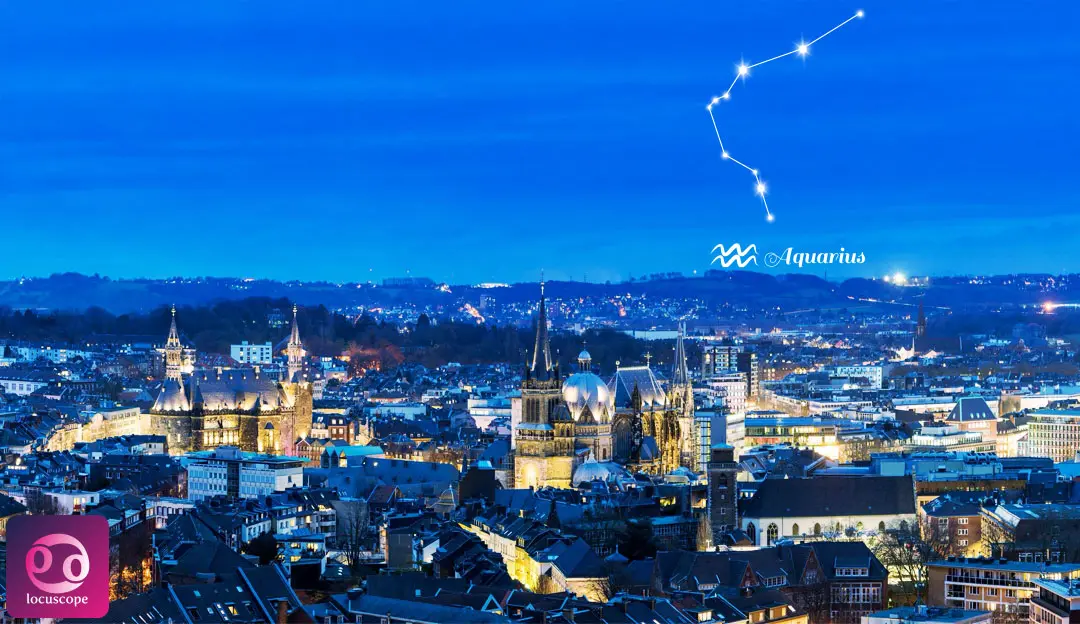
Wassermann
January 28, 0814
This date is recognized as the birthday because it marks the death of Charlemagne, who made Aachen the center of his empire. His burial in the city's cathedral cemented its status as the historic heart of Europe.
Standort
Aachen Der Vibe dieser Woche
Entdecke, welche Energien diesen Ort diese Woche beeinflussen
Early week, Aachen gets a wild spark. New ideas pop up everywhere. Locals feel it. Visitors feel it. Even the old stones seem to hum like they are plotting something. Expect sudden twists. A street that is usually calm may feel like it just drank three espressos. Aquarius season loves a shake up.
Midweek brings peak “don’t tell me what to do” vibes. Aachen goes rogue in the cutest way. Maybe the weather flips. Maybe a random festival appears. The city is craving freedom and showing off its quirky charm. Perfect time to wander without a plan. Let the city lead. It knows where the fun is.
By the weekend, the mood shifts. Still electric but softer. Like Aachen finally remembered sleep exists. The city turns into a chilled genius mode. Great for slow strolls, hidden corners, and surprising conversations that sound deeper than they need to be.
This week, Aachen is the friend who texts you at midnight with a weird idea that somehow works. It is unpredictable but lovable. A little eccentric but in the best way.
If you are in town, stay open. If you live there, buckle up. Aquarius energy does not do boring. A cosmic plot twist is coming and Aachen is ready to deliver.
Persönlichkeitsprofil
Though we mark January 28, 814, as the pivotal date for Aachen, this land carries the weight of an empire that defined the Western world. This date is not a beginning in the traditional sense, but a sanctification. It marks the death of Charlemagne (Karl der Grosse), the Frankish king who chose this steaming, sulfurous valley as his 'New Rome.' By dying and being interred in the Palatine Chapel he built, Charlemagne did not leave Aachen; he fused with it. His presence turned a geographic curiosity-a place of hot springs loved by Roman legionnaires-into the spiritual and political capital of the Holy Roman Empire.
For 600 years, German kings journeyed here to be crowned, sitting on the marble throne that still resides in the Cathedral. The geography of Aachen is inseparable from this destiny. Situated in the 'Three-Country Corner' (Dreilaendereck) where Germany, Belgium, and the Netherlands meet, it has always been a porous, international entity. It is a city that breathes European air. The hot springs that once soothed the Emperor's aching joints still bubble up today, filling the air with a distinct sulfuric tang that locals affectionately claim smells like home.
Culturally, Aachen is a fortress of tradition. The 'Oecher' dialect is a sing-song bridge between German and Dutch, unintelligible to many outsiders but fiercely preserved. The cuisine is equally dense and historic; the 'Aachener Printen' is not merely a gingerbread cookie but a hard, spiced relic of culinary history, protected by EU law and sweetened originally with sugar beet syrup when Napoleon blockaded the trade routes.
Modern Aachen wears its imperial robes lightly, draped over a body of youthful innovation. It is a premier university city, home to the RWTH, where the engineers of tomorrow are trained in the shadow of the cathedral. The International Charlemagne Prize, awarded annually for service to European unification, keeps the city's political relevance alive. It is a place where the ancient and the futuristic do not just coexist; they are the same entity, born from the ambition of a single man who dreamed of a unified continent over a millennium ago.
Tags
Die mystische Seele
Archetype: The Eternal Monarch. The Healing Water. The European conscience.
Aachen falls under the sign of Aquarius, the visionary and the humanitarian. This is a profound astrological fit for the city of Charlemagne. Aquarius is the sign of the collective, of networks, and of future-thinking ideals. Charlemagne didn't just conquer; he standardized writing, education, and currency. He was building a network-an Aquarian concept in a feudal age. The date of his death signifies the moment his physical power transformed into an ideology that would govern Europe for centuries.
Aquarius is an air sign, often associated with circulation and intellect, yet represented by the Water Bearer. Aachen literally bears water-its healing thermal springs. This duality defines the city: it is grounded in the earthy reality of stone and sulfur, yet its head is in the clouds of political idealism. The Aquarian energy here is fixed and stubborn. Once Aachen decides on a truth (like its status as the center of the empire), it holds that frequency for a thousand years.
If Aachen were a person: He would be a distinguished, eccentric professor with wild white hair and a Roman nose. He speaks four languages fluently but refuses to use modern slang. He spends his mornings soaking in a thermal bath reading philosophy, and his afternoons designing quantum computers. He is intimidatingly intelligent and holds himself with the posture of a king, yet he is deeply community-oriented, constantly organizing roundtables to solve global problems. He has a bit of a god complex, frankly, but since he has the resume to back it up, you let him have the head of the table. He is the grandfather of Europe, stern but visionary, demanding that the family stop fighting and build something together.