Jeju is a Leo
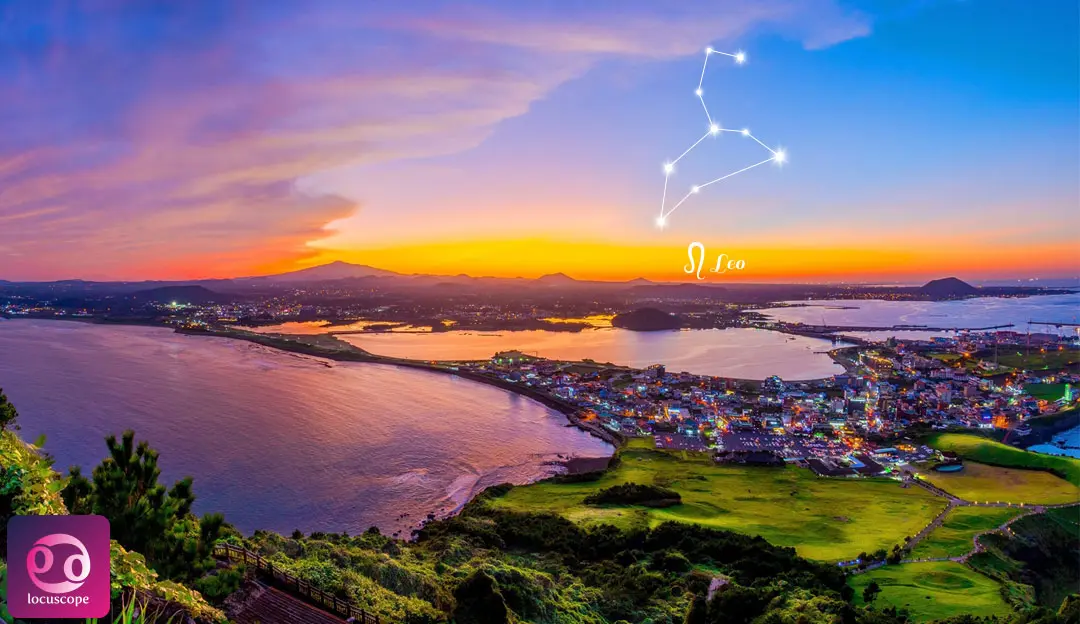
Leo
August 1, 1946
We accept this date as the birthday because it's when Jeju was officially separated from South Jeolla Province to become its own distinct, self-governing province, recognizing its unique island culture.
Location
Jeju This Week's Vibe
Discover what energies are influencing this place this week
Previous Vibes
Explore past weekly energies and cosmic influences
Personality Profile
Jeju is not the mainland. It is a world apart, a basalt kingdom built by the volcano Hallasan, which sits like a dormant god at its center. Its character is forged by the elements: the relentless wind, the black volcanic rock, and the surrounding sea.
This is an island of its own myths, its own (near-extinct) language, and its own icons. You see its spirit in the dol hareubang (stone grandfather statues) that guard village entrances, and most ofall, in the haenyeo. These "sea women," many in their 70s and 80s, free-dive into the cold ocean to harvest seafood, representing a fierce, matriarchal strength that defines the island.
But this paradise has a deep, dark shadow: the Jeju Uprising of 1948-49, a brutal suppression by the mainland government that killed tens of thousands and left a scar of silence for decades. Its 1946 "birthday," when it was finally separated from Jeolla Province, was a critical declaration of its unique identity. It was a statement: this island, with its goddesses, its divers, and its volcanic heart, governs itself. Today, it’s Korea's "Honeymoon Island," full of chic cafes and tourist trails, but that wild, resilient, and slightly tragic spirit is always just beneath the surface.
Tags
The Mystical Soul
Archetype: The Volcanic Heart. The Sea-Woman's Breath. The Island Kingdom.
Born August 1st, Jeju is a brilliant, fiery Leo. This is the sign of royalty, pride, and performance, ruled by the Sun. It’s a perfect fit. Jeju absolutely sees itself as special-a kingdom apart from the mainland. Its "birth" in 1946 was an act of pure Leo pride, demanding its own stage as a self-governing province.
What's a Leo without a throne? Jeju has Hallasan, the volcanic (fire sign!) mountain that sits at its very center. The entire island's modern identity is a Leo's dream: it's "Korea's Hawaii," a place where everyone comes to admire its beauty, play, and celebrate (Leo's favorite things). The haenyeo themselves are performers of incredible strength and endurance. But this Leo has a shadow. When its pride was attacked (the 1948 Uprising), the wound was deep and catastrophic. Its sunny, tourist-facing personality hides a profound, royal-level trauma.
If Jeju were a person, she's the impossibly beautiful, dramatic relative who lives on her own island. She shows up to family gatherings sun-kissed, wearing bright orange, and telling wild stories about diving for her own dinner. She’s the center of all attention, but if you cross her or bring up her dark past, the temperature drops 20 degrees. She’s warm and generous, but she is, and always will be, the queen of her own volcanic rock.