Kazakhstan ist ein Schütze
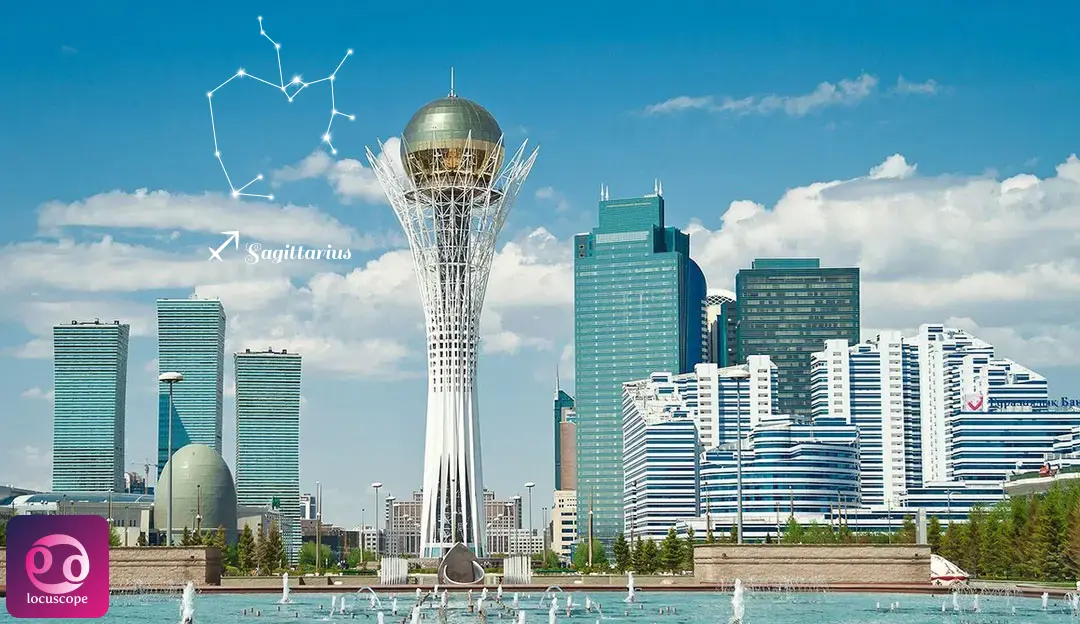
Schütze
December 16, 1991
This date is celebrated as Kazakhstan's Independence Day. On this day in 1991, Kazakhstan formally declared its sovereignty, becoming the last of the Soviet republics to declare independence during the dissolution of the USSR.
Standort
Kazakhstan Der Vibe dieser Woche
Entdecke, welche Energien diesen Ort diese Woche beeinflussen
Frühere Vibes
Entdecken Sie vergangene wöchentliche Energien und kosmische Einflüsse
Persönlichkeitsprofil
To understand Kazakhstan, you must first understand the horizon. This is the Great Steppe, the largest dry steppe region on Earth: an ocean of grass, wind, and sky so vast it defines the very soul of the people who cross it. For millennia, this land was not a place of settlement, but a place of movement. It was the world’s great highway, the cradle of the horse-riding nomad.
This is the land of the Scythians, the Turkic Khaganates, and the Golden Horde. Its history was not written in stone, but in the saddle. It was the engine of empires, the western reaches of the Silk Road, a place where tribes, ideas, and armies clashed and mingled under an endless sky. The eagle hunter (berkutchi) is not a folk-tale; it is a living memory of this mastership over a harsh, open world.
This nomadic identity was brought to a brutal halt by the 20th century. First came the Russian Empire, then the Soviet Union, which redrew maps, forced collectivization, and tried to pound the nomadic soul into a settled, industrial, Soviet shape. This era brought unimaginable trauma: the Asharshylyq, a famine that decimated the population, and the cultural and demographic upheaval of the "Virgin Lands" campaign, which imported millions from other republics. It became a dumping ground for exiles and the site of the Semipalatinsk nuclear test site, the "Polygon," which scarred the land and its people.
The Independence Day of December 16, 1991, is therefore a moment of profound, quiet weight. Kazakhstan was the last Soviet republic to declare independence. This was not a fiery, romantic break (like the Baltics); it was a pragmatic, necessary, and cautious step. It was the act of a nation, suddenly alone on the steppe, having to invent its own future.
The modern Kazakh character is this very duality. It is a nation of immense, newly-discovered resource wealth (oil, gas, uranium) that fuels futuristic, glittering cities like Astana (now Nur-Sultan), built by decree in the middle of the empty plains. It is a state that must constantly and cleverly balance the orbits of its two giant neighbors, Russia and China, while looking to the West. It is a nation seeking to reclaim its ancient nomadic, Turkic past while living in a complex, multi-ethnic, post-Soviet present.
Tags
Die mystische Seele
Archetype: The Eternal Nomad. The Pragmatic Archer. The Last Sovereign.
It is no coincidence that the world’s great nomadic nation was born a Sagittarius. This is the Centaur, the Archer, the philosopher-traveler of the zodiac. Kazakhstan is the Sagittarian soul made manifest.
Need proof? Its entire ancient identity is the literal man on horseback (the Centaur). Its history is defined by the Silk Road, the ultimate Sagittarian pursuit of travel, philosophy, and connecting distant cultures. But it’s the modern nation that seals the deal. Sagittarius is ruled by Jupiter, the planet of expansion, optimism, and big-picture thinking. What is more Sagittarian than its famous "multi-vector" foreign policy? This is the ultimate traveler’s philosophy: "Why pick one friend? I’ll be friends with all of you!" It is a pragmatic, expansive, and freedom-loving strategy to avoid being tied down.
The 1991 birth date shows this, too. A Sagittarian is a "big picture" thinker. As the USSR crumbled, Kazakhstan watched, waited, and assessed. Its decision to be the last to leave wasn't fear; it was the cautious, philosophical archer taking in the entire landscape before taking the shot.
If Kazakhstan were a person, he’s the guy who owns a ranch so enormous you can’t see the borders from his porch. He’s got an incredibly deep, ancient family history (Turks, Mongols) but a very traumatic recent past with an overbearing neighbor (the Soviet Union) who tried to change his entire personality. He’s fantastically wealthy (oil and minerals) and built a bizarre, futuristic glass palace (Astana) in the middle of nowhere just to prove he could. He's a philosopher at heart, always looking at the horizon. He hosts parties where his two biggest, most powerful, and mutually-suspicious business partners (Russia and China) are both in attendance, and he somehow, with a wry smile, keeps them both happy. He’s an optimist by necessity.
Its Sagittarian shadow is a tendency to gloss over deep traumas with big, shiny new projects, and a restless optimism that can sometimes border on over-promising, leaving the hard, detailed work of reform for later.