Kraków es un Géminis
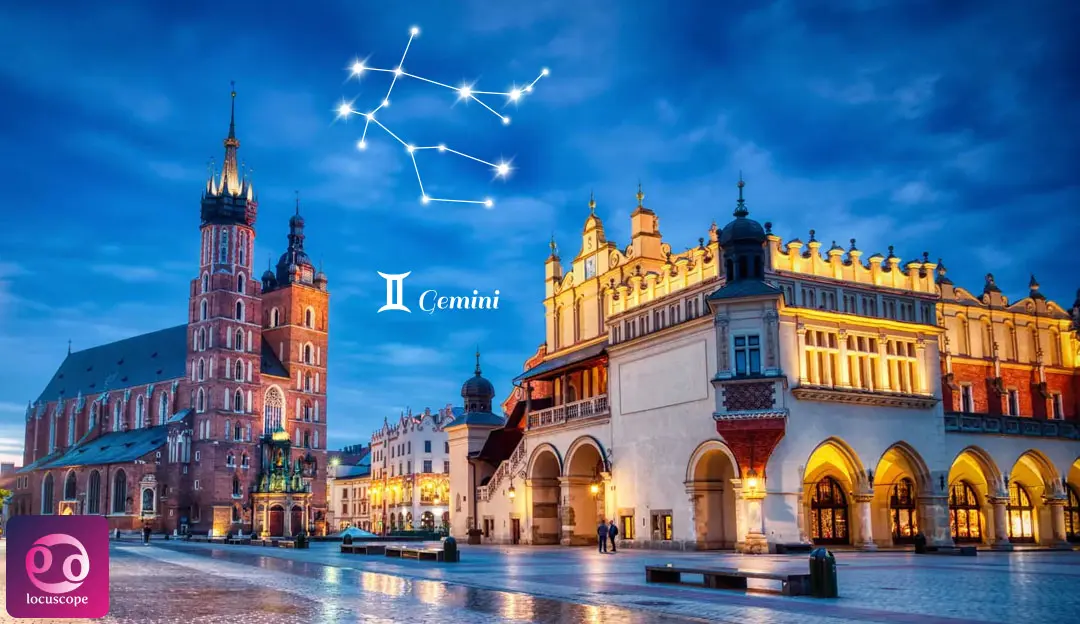
Géminis
June 5, 1257
We've designated this date as the birthday because it marks the 'Great Charter' granted to Kraków, which established its Magdeburg law layout, its famous market square, and its formal rights as the capital of the Polish Kingdom.
Ubicación
Kraków Vibra de esta Semana
Descubre qué energías están influyendo en este lugar esta semana
Early week energy is all chatter. Street corners feel louder. Cafés feel busier. Even the pigeons in Rynek seem extra gossipy. Kraków wants to spill tea, swap stories, flirt with tourists, and start three new plans before breakfast. Classic Gemini chaos. Classic Gemini charm.
Midweek brings a twist. A spark. A sudden desire to reinvent something. Maybe a new art pop-up. Maybe a random night market that was not here yesterday. Maybe you decide to wander Kazimierz and end up in a jazz bar you swear did not exist last week. Kraków loves surprises. This week it doubles down.
Expect the city to feel playful but restless. You might feel drawn to bounce between neighborhoods. Old Town to Podgórze to Nowa Huta in one afternoon. Do it. Kraków rewards the curious right now. The more you explore, the more the city opens up.
Weekend vibes shift into full social mode. Friends drag friends out. Plans multiply. Every event looks tempting. Every street feels like an invitation. The city wants company. It wants laughter. It wants a little mischief.
So talk. Wander. Say yes. Kraków is in Gemini sparkle mode, and the whole city is ready to flirt with your schedule. Enjoy the ride.
Vibras Anteriores
Explora las energías semanales pasadas y las influencias cósmicas.
Perfil de Personalidad
We mark the birth of modern Kraków on June 5, 1257. While the Wawel Hill had been inhabited for centuries prior, inhabited by kings and legendary dragon slayers, it was this date-the granting of the Great Charter based on Magdeburg Law-that transformed a chaotic medieval settlement into the geometric masterpiece we see today. This act of urban planning created the Rynek Glowny, the largest medieval market square in Europe. It imposed logic upon magic, creating a grid of streets that radiate from the Cloth Hall, a temple of commerce that has operated continuously for 700 years.
This city is the spiritual and intellectual capital of the nation. It was the seat of Polish kings long after the political capital moved to Warsaw. The very air here feels heavy with mythology. It is the home of the Jagiellonian University, one of the oldest in the world, where Copernicus studied the stars. The geography of the city reflects a dual nature: the high, fortified Wawel Castle representing royal authority, and the bustling merchant city below representing the chaos of life.
Culturally, Krakow is a 'state within a state.' Time moves slower here. The local ethos is defined by the cafe culture-hours spent over a single coffee discussing philosophy, art, or the end of the world. It is the city of the 'Piwnica pod Baranami' cabaret, a hub of political satire and poetry. It is a place where a trumpet signal (the Hejna?) is played every hour from the church tower, breaking off mid-note to commemorate a mythical scout shot by a Tartar arrow. Krakow does not run; it promenades.
Etiquetas
El Alma Mística
Archetype: The Royal Magician. The Eternal Student. The Golden Grid.
Born on June 5, Krakow is a quintessential Gemini. Ruled by Mercury, the planet of communication, commerce, and intellect, this sign explains the city's dual personality perfectly. It is at once a solemn necropolis of kings and a raucous center of student nightlife. It is the sacred and the profane dancing together in the Main Square.
The Gemini nature is evident in the city's survival strategy. Krakow rarely fought with brute force; it survived through negotiation, trade, and adaptability. During the partitions of Poland, while other cities were destroyed, Krakow became the repository of national memory, using words and art (Mercury's domain) to keep the Polish identity alive. The 1257 charter itself was a mercurial act-a contract, a deal, a piece of paper that reorganized reality.
If Krakow were a person: He is an eccentric aristocratic professor who wears a scarf indoors and smells faintly of old books and expensive cologne. He is charming, talkative, and knows a story about every cobblestone you step on. He lives in a museum but parties like a freshman. One moment he is reciting Latin poetry with profound gravity, and the next he is gossiping about a scandal from 1600 as if it happened yesterday. He is a flirt. He loves to be looked at, posing dramatically against the sunset. He is never in a hurry, often late because he stopped to buy a pretzel or argue with a pigeon. He carries a heavy sadness in his eyes from centuries of loss, but he covers it with wit and a toast of vodka. He is the life of the party, but he never lets you forget that he is royalty.