Libya es un Capricornio
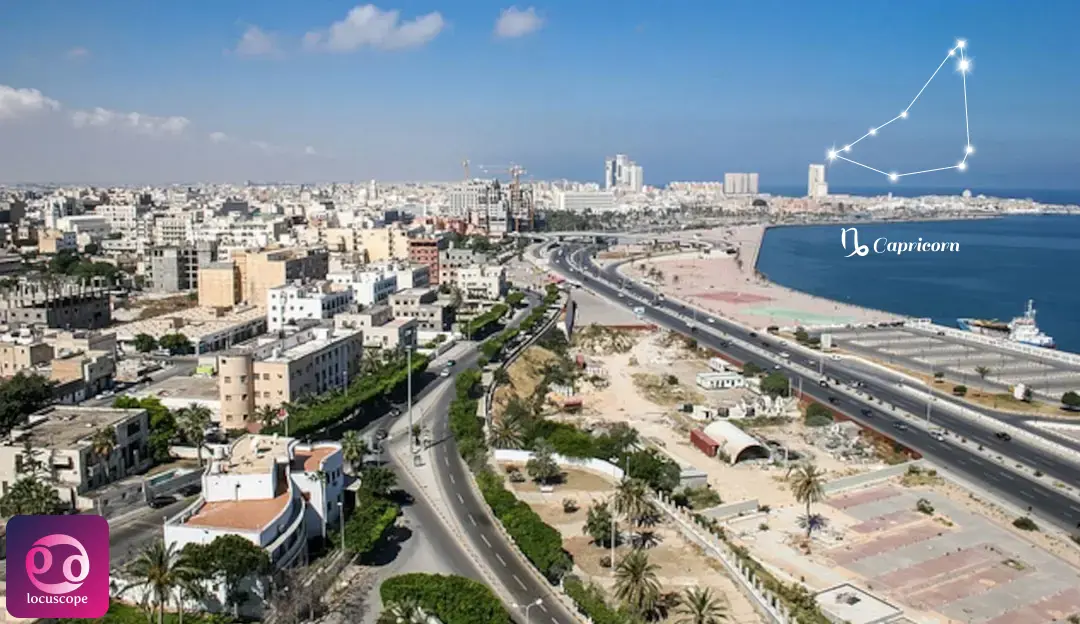
Capricornio
December 24, 1951
This date marks Libya's Independence Day. On this day in 1951, following a UN resolution, the United Kingdom of Libya was formally established, ending the post-war Allied administration and creating a sovereign state.
Ubicación
Libya Vibra de esta Semana
Descubre qué energías están influyendo en este lugar esta semana
Vibras Anteriores
Explora las energías semanales pasadas y las influencias cósmicas.
Perfil de Personalidad
Though we mark the 24th of December 1951, this land is an ancient, fractured stage for empires. To understand Libya, you must first understand that it is not one place, but three, held together by a shared, arid emptiness. It is a vast sea of Saharan sand with two historic "islands" of life on the Mediterranean coast-Tripolitania in the west and Cyrenaica in the east-and a third, the deep-desert Fezzan, in the south. This geography is the source of its power and its permanent, unresolved tension.
For millennia, this coast was a prize. It was the land of the Phoenician traders and the Greek philosophers of Cyrene. It was the Roman Empire’s breadbasket, home to the staggering, opulent city of Leptis Magna, which rivaled Rome itself. After the Vandal and Byzantine eras, the 7th-century Arab conquest gave the land its defining linguistic and religious soul.
But its modern identity was forged in resistance. After centuries as a semi-autonomous Ottoman province-known for its fearsome Barbary pirates-it was invaded by Italy in 1911. The Italians sought a "Fourth Shore," a new Roman Empire, but were met with a 20-year guerrilla war of brutal attrition, led by the stoic desert warrior Omar Mukhtar, the "Lion of the Desert," whose capture and public execution became the nation's foundational martyrdom.
The modern state was not born from this struggle, but from the ashes of another. After serving as a key battlefield in World War II, the land was left in post-war limbo. The 1951 date is not the end of a revolution; it was a UN resolution. It was a diplomatic creation, an arranged marriage that bound the three historically separate, mutually suspicious regions (Tripolitania, Cyrenaica, Fezzan) into a single Kingdom under King Idris.
This artificial unity was always its fatal flaw. The discovery of a liquid abundance of oil papered over the cracks, but it didn't heal them. In 1969, Muammar Gaddafi seized power, holding the fractured state together for 42 years through a bizarre cult of personality, immense oil wealth, and brutal force. When he fell in 2011, the 1951 arrangement finally, violently, disintegrated. The nation shattered back into its constituent parts, a land of ancient ghosts and modern militias still fighting over who gets to claim the whole.
Etiquetas
El Alma Mística
Archetype: The Fractured Kingdom. The Buried Treasure. The Lion of the Desert.
Born on December 24th, Libya is a Capricorn-a sign of structure, government, ambition, and ancient history. And this is the profound, tragic irony of the Libyan state. It was born under the sign of structure but has spent its entire life in a desperate, often-failed search for one.
Need proof? The 1951 date was the attempt to impose a top-down, Capricornian kingdom on a land that resists authority. Its hero, Omar Mukhtar, is a perfect Capricorn: the stoic, disciplined, unyielding elder, fighting for his land. Capricorn is an Earth sign, and Libya’s entire story is about its relationship with the earth: first as a Roman grain silo, and now as the source of its oil, its "buried treasure" and its curse. Gaddafi himself was a dark expression of Capricorn ambition-the ruthless "Father of the Nation" (a Saturnian title) obsessed with building his own rigid, bizarre structures.
If Libya were a person, he’s an old, proud patriarch sitting on a vast, valuable estate he can’t control. He was born from an arranged marriage (the 1951 UN deal) between three families who have always hated each other (Tripoli, Benghazi, Fezzan). He will show you photos from his glorious youth (Leptis Magna) and tell you stories of his heroic grandfather (Omar Mukhtar). He spent 40 years being controlled by a terrifying, charismatic, and insane relative (Gaddafi) who spent the family fortune and left the house in ruins. Now, he trusts no one, least of all his own family. He is a king who lost his kingdom, a Capricorn structure that has collapsed into a pile of very valuable, warring rubble.
Its Capricorn shadow is this very tyranny. It is the cold, rigid, authoritarian belief that only one strongman can hold the country together, leading to a cycle of ambition, suppression, and inevitable collapse.