Mongolia es un Capricornio
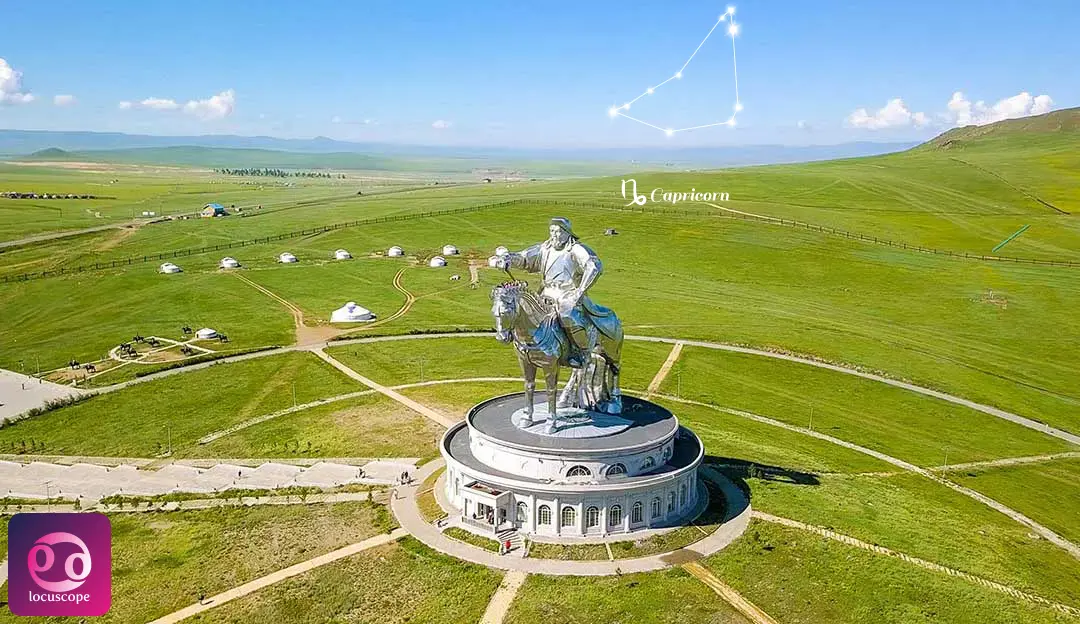
Capricornio
December 29, 1911
This date is celebrated as Mongolia's Independence Day. It marks the day in 1911 when, following the collapse of the Qing Dynasty, Mongolian leaders declared their independence and enthroned their spiritual leader as the Bogd Khan, establishing a sovereign state.
Ubicación
Mongolia Vibra de esta Semana
Descubre qué energías están influyendo en este lugar esta semana
Vibras Anteriores
Explora las energías semanales pasadas y las influencias cósmicas.
Perfil de Personalidad
Though we mark December 29, 1911, as its modern birth, this land is the cradle of the eternal blue sky, a civilization of the horse and the horizon. Mongolia’s character was not forged in a city; it was forged on the boundless, high-altitude steppe, a sea of grass under an infinite sky. This geography is not a backdrop; it is the central actor. It is a land of profound, brutal extremes-sun-scorched summers and -40 winters-that demands a soul defined by two things: absolute freedom of movement and unbreakable resilience.
This is the homeland of Chinggis Khaan (Genghis Khan). The West remembers him as a conqueror, but Mongolia remembers him as the unifier. He was the ultimate visionary who took scattered, warring nomadic tribes and organized them into the largest contiguous land empire in human history. He gave them a legal code (the Yassa), a writing system, and a singular purpose. This legacy is the core of the Mongolian identity: a quiet, almost genetic memory that this small population once held the entire world in its grasp.
After the empire's decline, Mongolia was absorbed by the Qing Dynasty for centuries. The 1911 date is not one of bloody revolution; it is one of opportunity and restoration. As the Qing empire collapsed, Mongolian leaders-the nobility and the spiritual hierarchy-met and declared their independence.
This was not a popular uprising; it was a strategic, political maneuver. And they did not found a republic; they enthroned their spiritual leader, the Bogd Khan, as the head of a new theocratic monarchy. It was an act of reclaiming their own ancient structure, blending statehood with the deep spiritualism of Tibetan Buddhism.
This act was soon overshadowed by the 20th century, as Mongolia became the world's second communist state, a satellite of the Soviet Union. This added a new layer: a capital, Ulaanbaatar, of brutalist architecture and Cyrillic script, standing in stark contrast to the timeless, nomadic life of the ger (yurt).
Today, modern Mongolia is a fierce, proud, democratic oasis caught between the two giants of Russia and China. Its character is quiet, profoundly hospitable (a nomadic law), and tough as leather. It is the sound of the morin khuur (horsehead fiddle) carrying across the plains, the athletic grace of the Naadam festival's "three manly games" (wrestling, horse racing, archery), and the unwavering gaze of a people who know how to endure.
Etiquetas
El Alma Mística
Archetype: The Enduring Bloodline. The Master of the Horizon. The Unspoken Law.
Born on December 29, Mongolia is a Capricorn. This is, perhaps, the most cosmically perfect, on-the-nose alignment in history.
Capricorn is the sign of structure, ambition, tradition, discipline, and the mastery of the material world. Mongolia’s entire history is a Capricorn story.
First, there is Genghis Khan, the quintessential Capricorn archetype. He was not a chaotic Aries warlord; he was a builder. He craved order. He took a world of chaos and structured it. He built a military, a legal code, a postal system, and a dynasty. His ambition wasn't just to conquer; it was to build an empire that would last. That is the Capricorn dream.
Second, the 1911 independence itself. This was not an emotional Cancerian plea for home or a fiery Leo charge for glory. It was a cold, pragmatic, and structural decision. The old structure (the Qing) was failing. So, the Capricorn leaders met to build a new, stable structure. And what did they build? A traditional hierarchy-a monarchy ruled by their highest authority, the Bogd Khan. This is Capricorn’s deep respect for order, status, and tradition made manifest.
Finally, the land itself. The steppe is a Capricorn landscape. It is harsh, unforgiving, and real. It strips away all illusion and demands pragmatism, endurance, and discipline. You cannot survive a Mongolian winter with anything less.
If Mongolia were a person, he’d be the old man sitting alone at the back of the room, who everyone assumes is just a quiet herder. Then you notice his hands-calloused from holding reins and building empires. He speaks rarely, but when he does, he quotes 800-year-old laws that still make perfect sense. He is the most powerful person you’ve ever met, but he wears a simple deel (traditional robe) and is more comfortable on a horse than in a boardroom. He respects tradition, strength, and the sky. He has seen empires rise and fall and knows his own lineage is greater than all of them. He’ll beat you at chess, wrestling, and long-term strategy, and then share his airag (fermented mare's milk) with you as if nothing happened. He is unimpressed by your money but will judge you on your ability to endure.