Morocco es un Escorpio
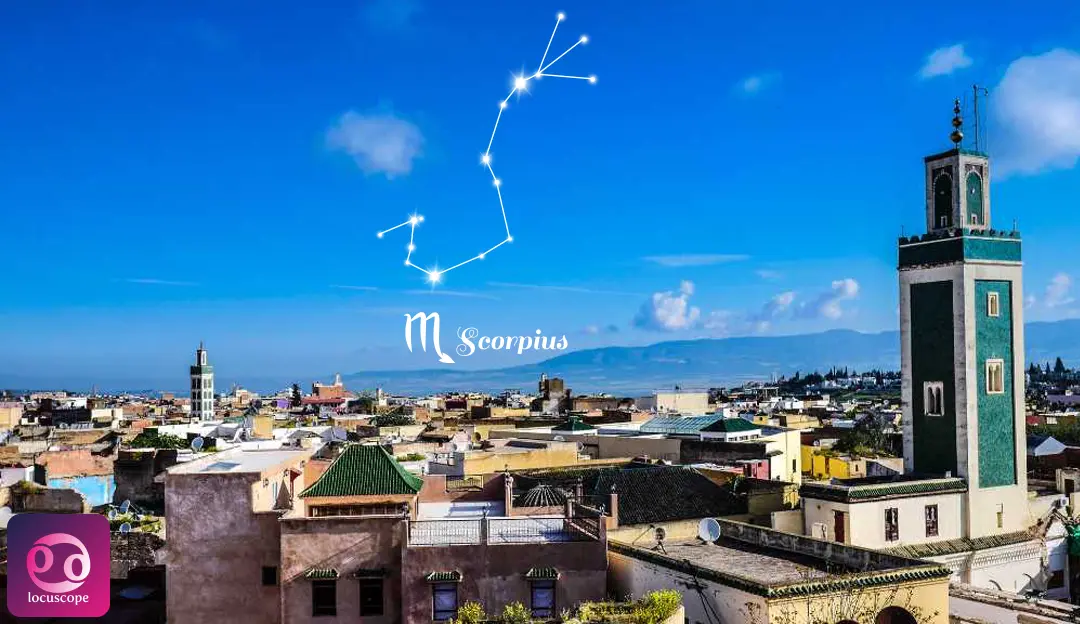
Escorpio
November 18, 1927
This date is celebrated as Morocco's Independence Day. It commemorates the accession to the throne of Sultan Mohammed V in 1927, who would become a central symbol of the independence movement and lead Morocco to its full sovereignty from French and Spanish protectorates in 1956.
Ubicación
Morocco Vibra de esta Semana
Descubre qué energías están influyendo en este lugar esta semana
Perfil de Personalidad
Though we mark November 18, 1927, as the symbolic dawn of its modern sovereignty, the soul of Morocco was forged by its geography millennia ago. This is not just a country; it is a fortress and a gateway. It is the Maghreb al-Aqsa, the "Farthest West" of the Arab world, a kingdom defined by its physical barriers: the vast Atlantic to the west, the endless Sahara to the south, and the formidable, snow-capped spine of the Atlas Mountains cutting through its heart.
This geography created a civilization of profound resilience, the homeland of the Imazighen (Berbers), its indigenous people. Their identity is the bedrock. This land then absorbed waves of history: Phoenician traders, Roman outposts, and the Arab conquest that brought Islam. But Morocco’s golden age was one of its own making. It was the heart of the great Berber empires-the Almoravids and Almohads-that, at their height, ruled an empire from West Africa to Al-Andalus in Spain. This is not the history of a mere colony; it is the history of an imperial power in its own right, a land of sophisticated artisans, fierce warriors, and profound scholars centered in the ancient, labyrinthine university-city of Fez.
The 20th century saw this kingdom carved into French and Spanish protectorates. This is where the 1927 date becomes so potent. It is not the date of a battle or a declaration. It is the day a young Sultan, Mohammed V, ascended to the throne. The French authorities backed his claim, believing a quiet, 18-year-old monarch would be a pliable figurehead for their colonial rule.
They miscalculated profoundly.
This date marks the beginning of a long, symbolic game of power. Mohammed V became the living symbol of the nation’s integrity. He was not a revolutionary firebrand; he was a center of gravity. He famously refused to implement Vichy France’s anti-Jewish laws during WWII, stating, "I have no Jews in my country, only Moroccan subjects." This quiet, unshakeable defiance is central to the nation's character. The French exiled him in 1953, an act which instantly backfired, turning him into a martyr and uniting the fractured independence movement. His triumphant return and the subsequent declaration of full independence in 1956 was not a revolution, but a restoration.
This history defines the modern Moroccan character: a blend of the trader, the mystic, and the king. It is a place of dizzying sensory detail-the controlled chaos of the Jemaa el-Fna in Marrakech, the smell of ancient tanneries in Fez, the communal art of a tagine. It is a place of deep privacy (the inward-facing riad) and intense public hospitality. It is a kingdom that understands strategy, patience, and the magnetic power of a single, unbending symbol.
Etiquetas
El Alma Mística
Archetype: The Veiled Gateway. The Magnetic King. The Ancient Artisan.
Born on November 18, Morocco is a Scorpio. This is, perhaps, the most powerful and accurate astrological placement on the map. Scorpio is the sign of secrets, hidden power, transformation, magnetism, and control.
Morocco’s entire identity is Scorpionic. Look at its culture and architecture: the medina is a labyrinth of high, windowless walls, a maze designed to protect its secrets. The riad is the ultimate Scorpio home: a blank, unassuming door in an alley that opens into a stunning, private, luxurious paradise. It is a culture that understands the power of what is hidden.
The 1927 birth date is a pure Scorpio power move. The French thought they were installing a pawn; they had no idea they were dealing with the king of the zodiac. Scorpio plays the long game. Mohammed V didn't throw a tantrum; he absorbed the pressure, bided his time, and transformed himself from a "protectorate Sultan" into the "Father of the Nation." He used their own power against them, a classic Scorpio judo-flip that led to a total "death and rebirth" of the nation.
And Morocco is a Kingdom. Scorpio is a sign of power, dynasty, and lineage. It is not a chaotic, revolutionary republic. It is a nation built on a deep, magnetic, and ancient authority that commands respect.
If Morocco were a person, he’d be an impossibly elegant older gentleman, draped in a fine djellaba, sitting in the medina. He sees everything. He’ll invite you for mint tea, and in the course of an afternoon, he’ll find out all your secrets while revealing none of his own. He is a master negotiator; you'll end up buying three carpets and feeling like you got the better deal. He has an ancient, magnetic authority. He’s deeply private (his house has no outward-facing windows) but intensely sensual-his world is one of saffron, rosewater, and old leather. He’s a king, a mystic, and a merchant all at once. Don’t ever try to cross him; his loyalty is absolute, but his memory is eternal.