Myanmar es un Capricornio
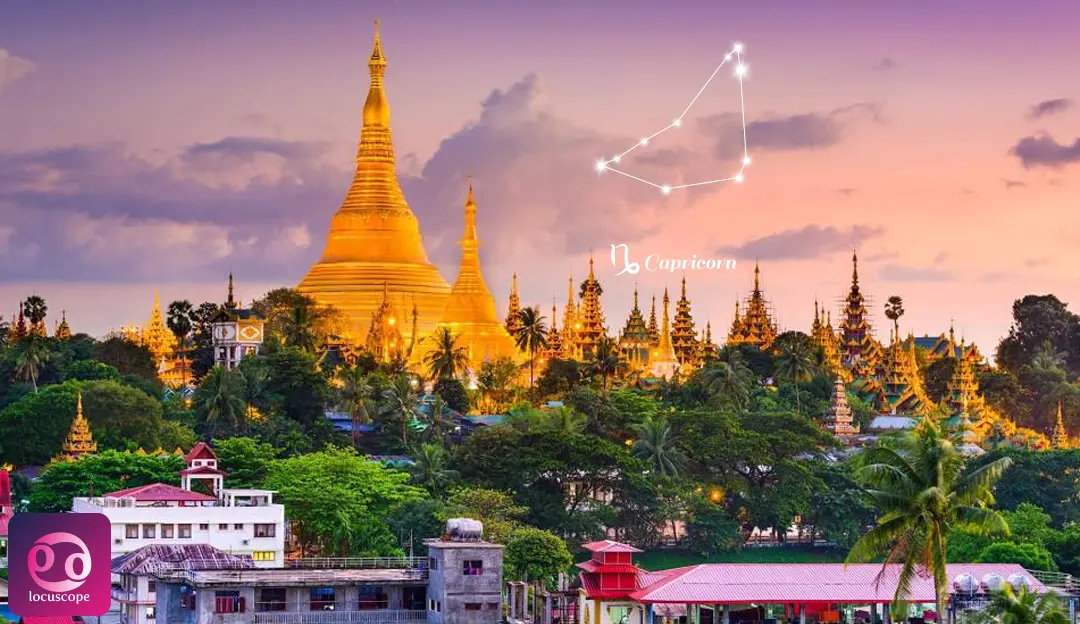
Capricornio
January 4, 1948
This date marks Myanmar's Independence Day. On this day in 1948, the nation, then known as Burma, formally gained its full sovereignty and independence from the United Kingdom, establishing the Union of Burma.
Ubicación
Myanmar Vibra de esta Semana
Descubre qué energías están influyendo en este lugar esta semana
Vibras Anteriores
Explora las energías semanales pasadas y las influencias cósmicas.
Perfil de Personalidad
Though we mark January 4, 1948, as its modern birth, this is the Suvarnabhumi-the "Golden Land"-a civilization that carries three millennia of history in the fertile silt of its great river, the Irrawaddy.
Myanmar's character was, and is, dictated by its geography: a broad, fertile central plain fed by the river, and protected (or imprisoned) by a horseshoe of dense, rugged highlands. The Irrawaddy is the nation's artery, the Bamar (Burman) people its heart. It was here, on the central plains, that the First Burmese Empire was forged at Bagan in the 11th century. This was the nation's cultural big bang: the establishment of Theravada Buddhism as the state's soul, an act of devotion so profound it resulted in over 10,000 temples and stupas being built on a single plain. This legacy of deep, daily faith is the country's spiritual spine.
But the highlands are its fractured limbs. The surrounding mountains are home to dozens of distinct ethnic groups-the Shan, the Karen, the Kachin, and many more-with their own languages, faiths, and warrior traditions. The history of Myanmar is the history of this eternal, unresolved conflict: the Bamar heartland attempting to control the highland peoples, and the highland peoples fiercely resisting.
The British colonial period did not solve this; it calcified it. By drawing borders that encompassed both the plains and the hills, the British created a deeply unstable entity. Independence, when it came, was not just about freedom from Britain; it was about its founding hero, Aung San, attempting to forge a union from these disparate parts.
His assassination just months before independence is the nation's original, tragic wound. This is why the 1948 date is so poignant. It was not a day of battle; it was a prophetic one, meticulously chosen by astrologers at 4:20 AM, an auspicious moment intended to secure the new nation's future.
This belief in the unseen-in astrology, in nat (spirit) worship, in karma-governs the soul of the nation as much as any political ideology. The modern character is one of profound, heartbreaking contradiction: a gentle, deeply pious people (seen in the universal thanaka paste and the graceful longyi) trapped in the world's longest-running civil war. It is the golden, serene face of the Shwedagon Pagoda overlooking a society defined by brutal military control, isolation, and a quiet, unbreakable resilience.
Etiquetas
El Alma Mística
Archetype: The Gilded Cage. The Patient Prisoner. The Unhealed Wound.
Born on January 4, Myanmar is a Capricorn. This is not a coincidence; it was a deliberate astrological choice. And no sign, in its highest and lowest forms, better explains this nation's fate.
Capricorn is the sign of structure, tradition, hierarchy, patience, and endurance. Myanmar’s entire culture is built on Capricornian foundations: a deep, abiding respect for the ancient traditions of Theravada Buddhism, and a society structured around the hierarchy of monks, elders, and family. The nation’s defining quality is endurance-the stoic, patient, and pragmatic ability to survive decades of civil war and isolation.
But the dark side of Capricorn is a brutal, cold authoritarianism. It is the sign of the iron fist, of rigid control, of isolationism ("the hermit"), and of a pessimism that trusts no one. The military junta is the shadow of Capricorn made manifest: a cold, calcified, top-down power structure that has locked the nation away from the world.
The 1948 independence was brokered by Aung San, the nation’s "father" (a Capricorn archetype), the great architect of its new structure. His assassination was the loss of that positive Capricorn leadership, leaving only the shadow side-control without compassion-to take its place.
If Myanmar were a person, she would be an incredibly graceful woman with an ancient, noble lineage, living in a beautiful house of teak and gold that she is not allowed to leave. Her face is painted with the cooling, protective thanaka, and she wears a simple longyi with priceless, uncut rubies sewn into the hem. She is profoundly devout, spending her days meditating and making offerings. She whispers about her first love (Aung San), who was murdered before their wedding, leaving her in the care of a cruel, uniformed guardian (the junta) who taps her phone and reads her mail. She is quiet, proud, and defined by a sadness that feels cosmic. She trusts no one, believes deeply in fate, and waits with inhuman patience for her karma to finally, finally, turn.