Apulia (Puglia) es un Piscis
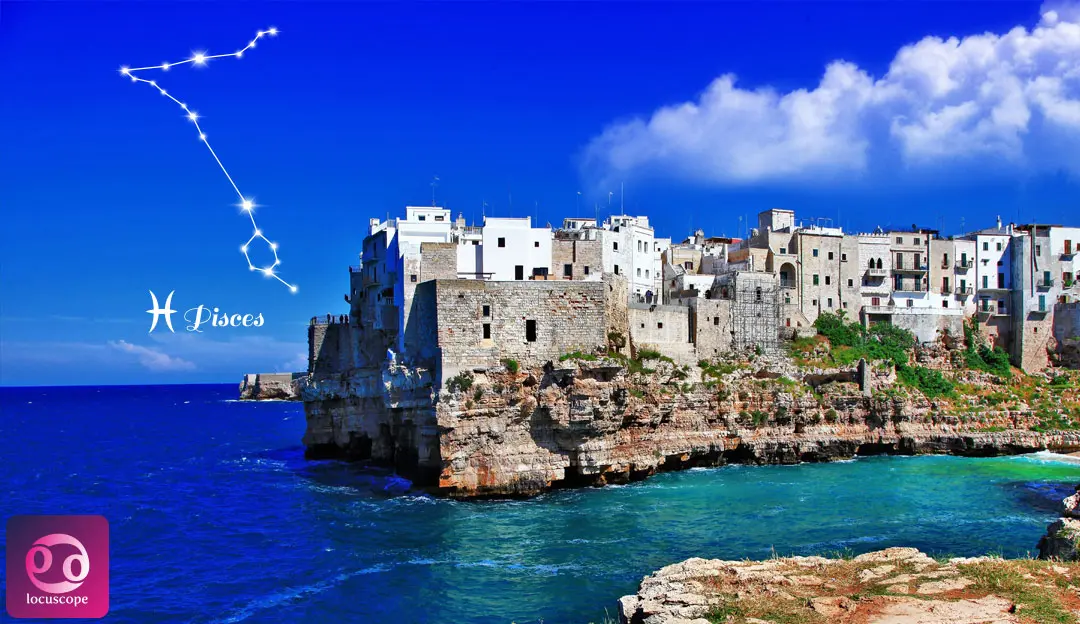
Piscis
February 23, 1059
We accept this date as the birthday because it's when the Norman leader Robert Guiscard was recognized as the 'Duke of Apulia and Calabria,' a key moment that politically unified the region.
Ubicación
Apulia (Puglia) Vibra de esta Semana
Descubre qué energías están influyendo en este lugar esta semana
Vibras Anteriores
Explora las energías semanales pasadas y las influencias cósmicas.
Perfil de Personalidad
Though we mark the Norman duke Robert Guiscard’s ascension in 1059, this land carries millennia of civilization in its sun-baked limestone. Apulia is not just a region; it is an argument. It is the "heel" of the Italian boot, a long, slender pier jutting into the Mediterranean, asserting itself between the Adriatic and Ionian seas. This geography is its destiny. It was never a fortress, but always a bridge-and a target.
Before Rome, it was a vital piece of Magna Graecia, a place where Greek colonists in Taranto grew rich. Rome paved the Via Appia to its port in Brindisi, making it the official gateway to the East, the launching pad for legions and emperors. After Rome's fall, it remained stubbornly Byzantine, looking east to Constantinople, not west to a fractured Europe.
The arrival of Robert Guiscard, a savvy and brutal Norman mercenary, was the moment this collection of Byzantine fragments and Lombard counties was forged into a single, Western-facing entity. The 1059 date we celebrate wasn't an independence day; it was an act of ambitious, pragmatic unification by an outsider. This set the tone for centuries. Apulia became the staging ground for the Crusades, a land layered with the ambitions of successive rulers: the brilliant, unconventional Swabian emperor Frederick II (the Stupor Mundi), who dotted the land with his sharp, enigmatic castles; the Angevins of France; the Aragonese of Spain.
This history of being possessed, passed, and prized created a character of profound resilience. Apulian culture is the art of turning nothing into everything. Its cucina povera (peasant cuisine) is a philosophy of genius: taking humble flour and water to create the signature orecchiette (little ears) pasta, or elevating wild greens and fava beans. Its landscape is dominated by millions of ancient, gnarled olive trees, sculptures of endurance that produce Italy's richest oil.
Today, Apulia is where Italy's agricultural soul meets the honey-gold, theatrical stone of Lecce's Baroque architecture and the dazzling, whitewashed mazes of cities like Ostuni. It moves to a slower rhythm, one dictated by the harvest and the sea. It has seen empires rise and fall from its ports, and it knows that true strength isn't in power, but in patience.
Etiquetas
Explorar dentro de Apulia (Puglia)
Descubre lugares dentro de Apulia (Puglia) y sus perfiles astrológicos
El Alma Mística
Archetype: The Sun-Bleached Mystic. The Patient Survivor. The Gateway to the Dawn.
Born February 23rd, Apulia is a Pisces, and it could be no other. Pisces is the final sign of the zodiac, the old soul that has absorbed the lessons of all who came before. This is the perfect identity for a land that is a synthesis of Greek, Roman, Byzantine, Norman, and Spanish energies. Its very element is Water, defined as it is by two seas. It is the literal end of the line (the Via Appia), the final point before plunging into the unknown-a classic Pisces theme of bridging the material and spiritual worlds.
This Piscean soul isn't just theory; it’s written into its mystical DNA. This is the land of Padre Pio, one of modern Catholicism's most revered and controversial mystics. It is also the home of the pizzica, a frenetic, trance-like dance. Originally a folk ritual to "cure" the venom of a spider bite, it is a raw, Piscean expression of communal exorcism, dancing out the poison, the trauma, and the madness.
If Apulia were a person, she’d be the family nonna who sits on a stool outside her whitewashed house, hand-rolling orecchiette purely from memory. She wears practical black but has a wicked, knowing smile. She’s deeply, almost frighteningly, intuitive. She doesn't talk much about the past, but you can see the Greeks, the Saracens, and the Normans in the depths of her eyes. She’ll feed you until you burst, insisting "Mangia!" (Eat!), because for her, food is survival and love is resilience. She’s the one who still knows the old cures, who whispers to her olive trees as if they are family, and who will dance the pizzica at a village wedding with a fiery abandon that shocks the young. She has seen everything, and she is impressed by absolutely nothing. Her shadow side is this Piscean fatalism-a long-held belief that the North will always get the attention, and her own role is simply to endure.