Zaragoza é um Sagitário
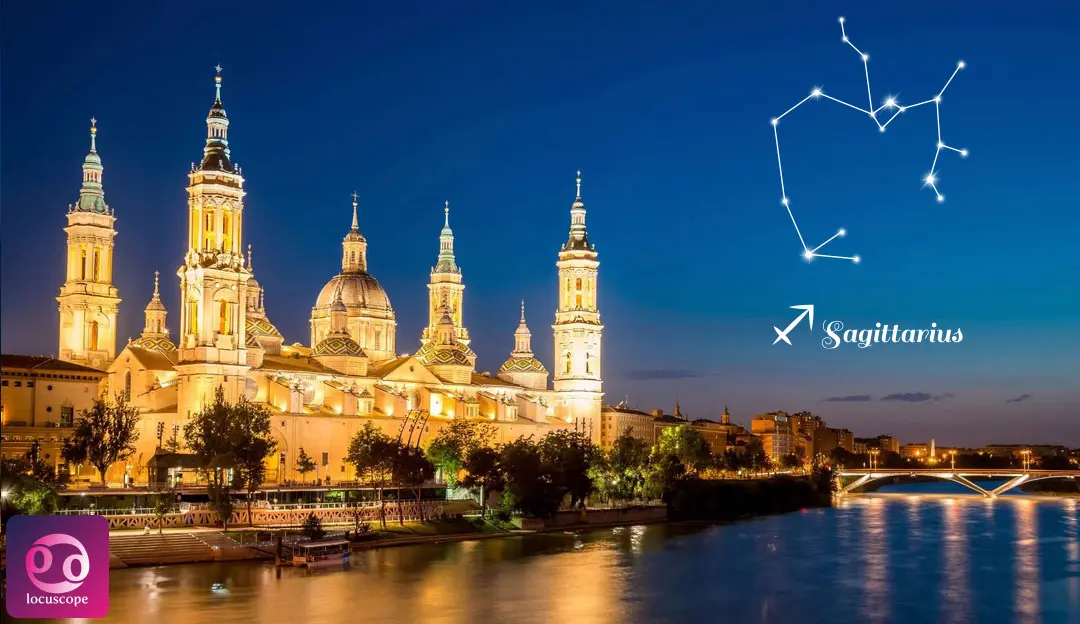
Sagitário
December 18, 1118
We've designated this date as the birthday because it marks the momentous conquest of the great Muslim city of Saraqusta by King Alfonso I 'the Battler,' who then made it the new capital of the Kingdom of Aragon.
Localização
Zaragoza Vibração desta Semana
Descubra quais energias estão influenciando este lugar esta semana
Vibrações Anteriores
Explore as energias semanais passadas e as influências cósmicas
Perfil de Personalidade
There is a wind here called the Cierzo. It does not merely blow; it scours the Ebro valley, stripping away pretense and leaving only what is solid. This unrelenting force has shaped Zaragoza just as much as the four distinct civilizations that built upon this riverbank. Though we mark December 18, 1118, as the definitive shift-the day Alfonso I the Battler stormed the city and transformed Muslim Saraqusta into the capital of Aragon-this land carries millennia of memory. Before the Aragonese cross, there were Roman walls, Visigothic stones, and the sophisticated geometry of the Moors.
To walk through Zaragoza today is to walk through a geological cross-section of Spanish history. The Aljaferia Palace stands as the most northern Islamic palace in Europe, a delicate jewel of intricate plasterwork, yet it houses a modern parliament. Just down the road, the colossal Basilica of Our Lady of the Pillar dominates the skyline, a baroque temple that acts as the spiritual living room for the entire Hispanic world. This juxtaposition is not accidental; it is the result of a city that refuses to erase its scars, preferring to build on top of them.
The birth date of 1118 introduced a specific kind of hardiness. When Alfonso the Battler took the city, he brought with him the rough pragmatism of the mountain kingdoms. That spirit survives in the modern "Mano" character: noble, brutally honest, and famously stubborn. In local parlance, this obstinacy is celebrated as a virtue. It is the drive that kept the city standing during the Napoleonic sieges, a resistance so fierce it became legendary across Europe.
Today, Zaragoza is a logistics powerhouse, a crossroads connecting Madrid, Barcelona, and France. But do not mistake its logistical efficiency for a lack of soul. Visit the "Tubo" district on a Thursday night, where tapas bars overflow into the narrow streets. The dish of choice is Ternasco (roast lamb), simple and rich, much like the city itself. Here, history is not a museum piece; it is something you lean against while drinking wine, bracing yourself against the wind that has been blowing since the Romans laid the first stone.
Tags
A Alma Mística
Archetype: The Windy Crossroads. The Imperial Survivor. The Stone stubbornness.
Born under the expansive fire of Sagittarius, Zaragoza is a city of grand gestures and philosophical depth, but with a unique twist: it is a Sagittarius forged in the bitter cold of the Aragonese winter. The conquest of 1118 was a crusade, a movement of immense religious and territorial expansion, perfectly aligning with the Archer's quest for higher meaning and broader horizons.
This is a city that aims its arrow high. You see this Sagittarian largesse in the Basilica of the Pillar-it is not just a church; it is a massive, overwhelming statement of faith that screams, "We are the center of the world." However, the ruling element of Fire here is tempered by the dry, howling wind. This creates a personality that is less about flighty travel and more about enduring presence. The shadow side of this chart is a legendary inflexibility. Once Zaragoza decides on a truth, whether it is a political stance or the quality of a local wine, no force on earth can change its mind.
If Zaragoza were a person: He is a broad-shouldered man in his late fifties, his face weathered by the sun and the Cierzo wind. He wears a heavy wool coat regardless of the season and speaks with a volume that startles outsiders, though he thinks he is whispering. He is the kind of guy who will argue with you for three hours about the correct way to cook migas (breadcrumbs with chorizo) until you are exhausted, only to then pay for your entire dinner and invite you to stay at his house for a week. He carries a pocketknife and cuts his own cheese. He is deeply skeptical of new trends, preferring things that have lasted at least three centuries. If you get into a fight, he is the first one to jump in, not because he likes violence, but because loyalty is the only currency he respects. He is loud, overwhelming, and impossible not to love once you understand that his stubbornness is actually a form of protection.