Baton Rouge 双鱼座
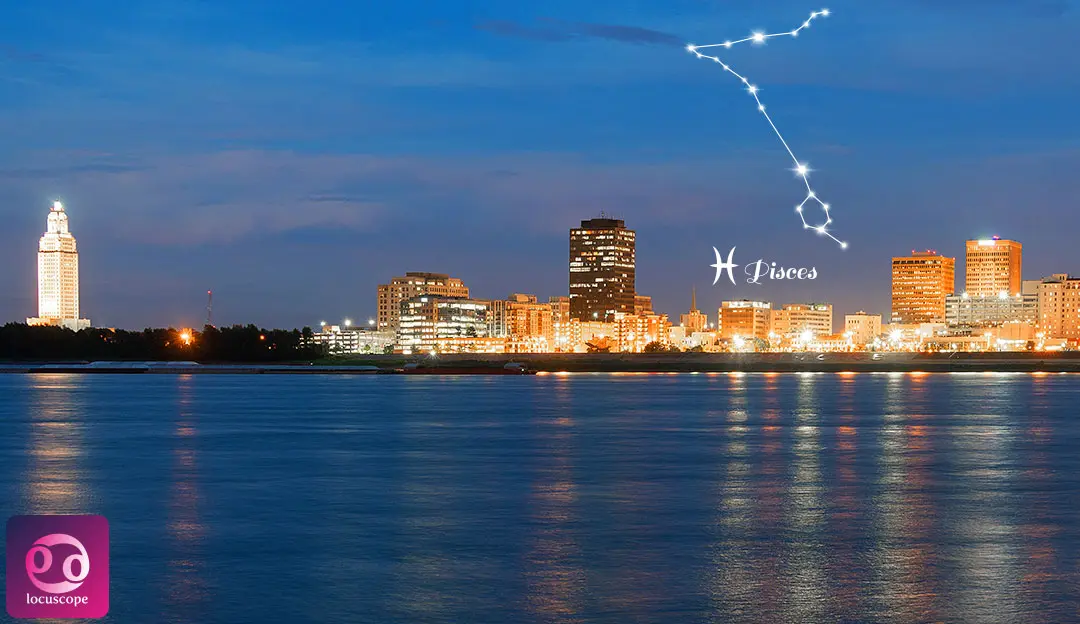
双鱼座
March 17, 1669
We accept this date as the birthday because it marks the moment French explorer Pierre Le Moyne d'Iberville noted a red cypress pole marking the boundary between tribal lands, naming the spot 'le bâton rouge' (the red stick) and giving the future capital its name.
地点
Baton Rouge 本周能量
发现本周有哪些能量正在影响这个地方
以前的能量
探索过往每周能量与宇宙影响
个性档案
In the murky waters of history, clarity often comes from a single point of reference. For Baton Rouge, that reference was literal: a blood-red cypress pole stripping the bark from the landscape, marking the hunting boundaries between the Houma and Bayou Goula tribes. When Pierre Le Moyne d'Iberville documented this 'le baton rouge' on March 17, 1669, he did not just name a location; he identified a center of gravity.
While its southern neighbor New Orleans floats on a sensory cloud of jazz and indulgence, Baton Rouge stands firmly on the bluff. It is the industrial engine and the political brain of Louisiana. The city's character is defined by this elevation-safe from the floodwaters that plague the coast, making it a natural fortress for governance and education. It is a place of petrochemical prowess and legislative maneuvering, where the monolithic State Capitol building-the tallest in the nation-pierces the sky much like that original red stick. Today, the city balances the frenetic energy of SEC football culture with the sober realities of policy-making, remaining the boundary keeper between the wild Atchafalaya Basin and the structured world of commerce.
标签
神秘灵魂
Archetype: The Red Boundary. The River's Architect. The Dreaming Bureaucrat.
Born under the sign of Pisces, Baton Rouge presents a fascinating astrological paradox. Pisces is the sign of boundary dissolution, of merging with the infinite, yet this city was birthed by the very act of drawing a line in the mud. This creates a vibration of constant fluidity contained within rigid structures. The sun in Pisces gives the city an undercurrent of adaptability and hidden depth, essential for a capital that must absorb the chaotic emotions of an entire state. The 1669 date suggests a soul that is old enough to know the secrets of the river but fluid enough to reinvent its industry.
If Baton Rouge were a person, he would be a sharp-dressed political strategist who keeps a fishing rod in the trunk of his luxury sedan. He is the guy at the party who is ostensibly there to work the room and shake hands, yet he ends up on the back porch having a deep, philosophical conversation about the nature of existence with the bartender. He wears purple and gold not just as colors, but as a uniform of loyalty. He is deeply intuitive, sensing shifts in the political wind before they happen, but he masks this psychic sensitivity with a thick layer of industrial pragmatism. He loves a debate, not to win, but to blur the lines until you agree with him. His shadow side is murkiness; like the Mississippi sediment, he can be impossible to read, hiding his true intentions behind a fog of bureaucratic procedure and humidity.